

Berlin Court Orders Foreign Election Interference — And Calls It Democracy

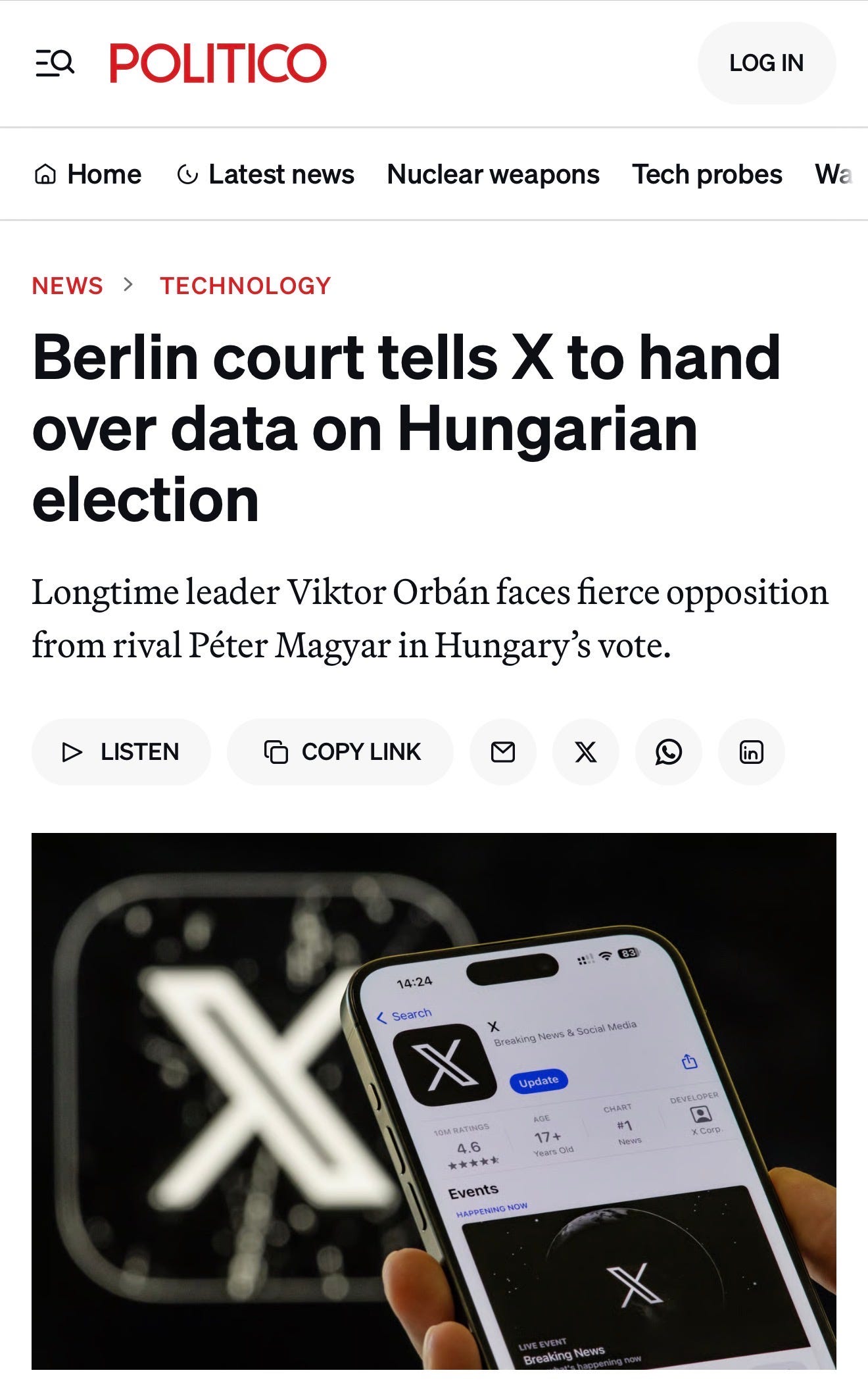
February 2025: Democracy Reporting International goes to a Berlin court. Demands X hand over election data on Germany. Court says no. Cannot compel a platform to surrender domestic election data without meeting a higher evidentiary bar.
February 2026: Same organization. Same court. Different demand. This time they want data on Hungary’s election. Court says yes. Same researchers who couldn’t access German election data can now access Hungarian election data. What changed? Simple. It’s not their election anymore. It’s someone else’s. And the government they’re studying is one Brussels has been trying to remove for a decade.
They tried this in Romania last year. Constitutional Court annulled the first-round presidential election in December 2024, two days before the runoff, citing “Russian interference” via TikTok after a candidate Brussels didn’t like — Calin Georgescu, pro-sovereignty, anti-Ukraine funding — won the first round with zero reported campaign spending. US House Legal Committee released a report in February 2026 saying the EU interfered in Romania’s election, not Russia. Election was re-run in May 2025. Pro-EU candidate won. JD Vance called the annulment “Soviet-era practice.” Tens of thousands of Romanians protested in Bucharest. Didn’t matter. Brussels got its outcome. Now it’s Hungary’s turn.
Democracy Reporting International. Michael Meyer-Resende, executive director. Former advisor to the German Ministry for Economic Cooperation. Funded 47% by the German government. Funded 26% by the European Union. The same EU currently withholding €18 billion from Hungary — that’s €1,800 per Hungarian citizen, hospitals that won’t be built, schools that won’t be funded, infrastructure that won’t be built.
What Brussels calls “rule of law violations” translates to: Viktor Orban won’t fund our suicidal war in Ukraine’s , won’t accept migration quotas forced on sovereign nations, won’t cut energy from Russia that keeps Hungarian homes heated in winter, won’t vote the way Ursula von der Leyen demands. Hungary holds elections. Has opposition parties. Has media that criticizes Orban every single day. But the European Parliament declared it “no longer a full democracy” in 2022 because Orban keeps winning and won’t comply with Brussels’ agenda.
A foreign court. Ordering data. On a sovereign nation’s election. Two months before that nation votes. Under a law the foreign court’s government helped write. That’s what the Berlin Court of Appeal just did. Article 40 of the Digital Services Act — the provision letting “vetted researchers” access platform data to study “systemic risks” like election interference. Sounds defensive until you notice the researchers work for governments with a preferred outcome and the election they’re scrutinizing is the one where their preferred candidate is supposed to win.
Peter Magyar is Orban’s challenger. Former Fidesz insider. Ex-husband of Orban’s former justice minister. Promises to “unlock” €18 billion in EU funds by bringing Hungary into alignment with Brussels. Will support Ukraine. Will accept migration policy Brussels dictates. Will vote with the Commission. And Western media, the same outlets that assured you Georgescu in Romania was a Russian plant, the same polling firms Brussels funds now tell you Magyar is leading by 5-10 points.
Polling in Hungary shows Fidesz (Orban) leading by similar margins. Orban’s Sovereignty Protection Office accuses pollsters of “abusing public opinion research” and “carrying out foreign assignments.” Hungarian political scientist Gabor Torok, no Fidesz loyalist, says the gap between government-aligned and opposition-aligned polls is “unexplainable on research grounds.” That’s academic language for: someone’s lying. Either the Hungarian government is manufacturing its own leads or EU-funded pollsters are creating a Magyar surge that doesn’t exist to demoralize Orban supporters and justify the intervention that’s now happening.
Here’s what Western coverage won’t tell you. If Magyar actually had the support these polls claim, none of this would be necessary. If Hungarian voters genuinely wanted Brussels’ candidate, EU-funded researchers wouldn’t need German court orders to access Hungarian election data. If the people of Hungary were crying out for alignment with von der Leyen’s migration and disastrous energy policies alongside Ukrainian war funding, Magyar would win on his own and this entire apparatus — the court orders, the DSA enforcement, the researcher access, the fact-checker coordination — would be redundant. The machinery exists because the outcome is so far from guaranteed. The interference is the tell.
This is the same Digital Services Act regime that just moved its coordination into darkness. EU officials holding DSA workshops as closed-door events. Coordinating censorship operations on Signal with auto-delete enabled. Politico reported it this week — the space for open debate has shrunk, so Brussels moved the workshops behind closed doors where messages disappear and voters can’t see what’s being coordinated. “The online space should not be a black box,” says Meyer-Resende. His organization’s funders operate inside one.
Here’s the dirty civilizational pattern and it’s not new. What Washington called “democracy assistance” when it funded violent opposition militias in Latin America. What Europe called “exporting governance standards” when it imposed structural adjustment on Africa. What NATO called “humanitarian intervention” in Libya, in Syria, in Yugoslavia before that. The vocabulary changes depending on which decade you’re in and which empire is doing the exporting. The mechanism never does. Find a government that won’t comply with your demands. Withhold funds until the population hurts. Support opposition candidates who promise alignment. Generate polling — through coercive organizations you fund — showing your candidate winning. Use weaponized legal frameworks to pressure platforms. If the election goes wrong anyway, annul it and cite foreign interference. Worked in Romania. They’re trying it in Hungary.
The Berlin Court of Appeal just ordered data on a Hungarian election handed to researchers funded by Germany and the EU. Read that again. A foreign government’s court ordering data on a sovereign nation’s election through researchers it pays. Hungary is a sovereign nation. NATO member. EU member state. Holds regular elections with opposition parties, independent media, courts that rule against the government. The candidate Brussels opposes has governed for sixteen years and maintains support despite €18 billion in withheld EU funds and coordinated Western media campaigns calling him authoritarian. The candidate Brussels supports promises to unlock that money in exchange for policy alignment. And now EU-funded researchers get court-ordered access to platform data on an election where Hungarians — not Germans, not Brussels bureaucrats, Hungarians — are supposed to decide who governs their country.
This is Brussels deciding which governments are legitimate and using courts in member states to enforce compliance. This is a foreign court ordering access to a sovereign nation’s election data two months before that nation votes. This is the EU doing to Hungary what it did to Romania while projecting their interference onto Russia. Same legal framework. Same justification. Different target.
If Magyar had genuine Hungarian support, Brussels wouldn’t need to withhold €18 billion to create the economic pressure that makes “unlocking EU funds” sound appealing. The polling wouldn’t require EU-funded organizations. The researcher access wouldn’t need court orders. The interference machinery wouldn’t exist. They’re building it because they’re not confident Hungarians will choose what Brussels dictates.
Hungary’s election is Hungary’s business. Not Berlin’s. Not Brussels’. Not Meyer-Resende’s paid researchers. Not the Digital Services Act enforcement apparatus. Not the fact-checkers coordinating in darkness on Signal. Hungarians will vote on April 12. Whether that vote gets respected or annulled — whether the results stand or get overturned by courts citing interference — whether Hungary remains sovereign or becomes another Romania — that will tell you everything you need to know about what the EU has become.
Orban’s been saying for years Brussels wants regime change in Budapest. They called him paranoid. Authoritarian. Anti-democratic. Turns out he wasn’t any of those things. He was just early.
What happens April 13? The free analysis ends here. Paid subscribers get scenario projections, why Brussels faces an existential crisis regardless of outcome, what it means for Russia and the Trump administration, and why Hungary’s election matters more than Ukraine’s territorial integrity to the future of the European project.👇
What Happens Next: Why Brussels Is Screwed Either Way
Here’s what nobody’s saying: Brussels is trapped.
If Orban wins on April 12, they lose their leverage permanently and watch sovereignty movements spread across the bloc. If they annul the election via dirty tricks and soft coup, they prove every “authoritarian Brussels” accusation beyond a reasonable doubt and risk fracturing the EU beyond repair. There’s no good outcome for von der Leyen. Only degrees of catastrophe.
And they’re trying to execute this regime-change operation while the economic foundation of the entire European project is collapsing underneath them. Slovakia’s Fico just called it “the worst crisis in EU history.” He’s not wrong, but he’s not going far enough. Germany — the EU’s largest net contributor at €18 billion annually — just posted its third consecutive year of recession. The Federation of German Industry calls it the “deepest crisis in post-war history.” Industrial production down four straight years. Twenty-four thousand corporate bankruptcies in 2025 alone. The Handelsblatt Research Institute projects Germany won’t return to 2019 GDP levels until 2031. That’s twelve years of economic stagnation. And Germany’s supposed to fund Brussels’ Hungarian adventure while German factory workers get laid off and Trump threatens 20% tariffs on whatever’s left of their export sector.
France is paying €9 billion net into the EU budget while its own economy sputters and Le Pen polls at 31%. The fiscal math of the European Union only works if Germany and France keep writing checks. But Germany’s check just bounced — their net contribution fell €4 billion in 2024 because the economy contracted. If German GDP keeps shrinking and Brussels keeps withholding billions from Hungary to punish Orban, where does the money come from? You can’t run a continental intervention budget on a recession-era tax base. The EU’s trying to execute regime change in Budapest while the regime in Brussels can’t pay its own bills.
The Structural Difference: Why Hungary Isn’t Romania
When Romania’s Constitutional Court annulled Georgescu’s first-round victory in December 2024, the establishment could do it because Georgescu had no institutional power base. Independent candidate. Zero campaign spending. No party infrastructure to contest the annulment. Romania’s courts were controlled by the pro-EU establishment.
Easy target.
Orban isn’t Georgescu. He’s been in power sixteen years. He can count on Hungary’s Constitutional Court — packed it between 2011 and 2013, appointed every judge with Fidesz’s two-thirds majority. Hungarian constitutional law says the court cannot annul laws passed by a two-thirds parliamentary majority. Orban has that majority. He’s spent a decade and a half building constitutional fortifications specifically to prevent what happened to Romania. If Brussels tries to annul a Hungarian election, they’ll have to do it from outside Hungarian jurisdiction via the regime change playbook.
German courts ordering Hungarian election data isn’t annulment. It’s reconnaissance.
But Article 7 suspension of Hungary’s voting rights? That requires unanimous agreement from all other EU members. Orban’s been building alliances. Slovakia’s Fico will veto it — he just called Ukraine a “black hole” of corruption and demanded Kaja Kallas’ removal as EU foreign policy chief. Meloni might veto if Italian interests align with resisting Brussels overreach. One veto kills Article 7. Brussels can’t pull a Romania here without extraordinary legal gymnastics that would make the “emergency” COVID-era power grabs look restrained by comparison.
And here’s what makes this court order dangerous for Brussels: it documents the mechanism. For years, EU pressure on member states operated through backroom threats and quiet fund withholding. Now there’s a paper trail. Berlin Court of Appeal. Article 40 DSA. EU-funded researchers. Foreign election data two months before voting. The intervention is visible in a way it’s never been before. That’s not just a problem for Hungary. That’s a problem for every member state watching and thinking: “If they’ll do this to Hungary, what stops them from doing it to us?”
Scenario One: Orban Wins Clean
If Orban wins and Brussels can’t or won’t risk regime change, the €18 billion stays frozen. Orban doesn’t care anymore. He’s proven he can win without it. That destroys the entire premise of withholding funds as leverage.
Within 72 hours of victory, he cements the Adria pipeline arrangement with Croatia and signs a ten-year Russian oil contract via maritime delivery. The Druzhba pipeline has been shut off since January — and Ukraine refuses to repair and reinstate flows in what Moscow rightlycalls ‘political blockage.’ MOL’s already sourcing Russian crude through Croatia’s Adria pipeline. Orban makes it permanent. Yes, Hungary could diversify to non-Russian suppliers via the same route. That’s what Brussels wants. Orban does the opposite. Locks in Russian oil for a decade, seaborne instead of pipeline, but the dependency stays. Brussels can’t feed Hungarian families. Moscow can — one way or another.
Then he coordinates with Fico in Slovakia. Two EU members with locked-in Russian energy, blocking Ukraine accession, vetoing sanctions packages every six months when they come up for renewal. Meloni in Italy watches this and recalculates. She’s been playing both sides — pro-EU on Ukraine, anti-EU on migration and climate. If Orban wins and survives Brussels’ retaliation, Meloni has political cover to stop compromising.
She doesn’t need to join Orban’s faction formally. She just needs to start voting with him on key issues.
Three major EU economies operating as a de facto sovereignty bloc inside the Council. Hungary, Slovakia, Italy. Brussels’ legislative agenda grinds to paralysis because unanimity is required and three member states have demonstrated that defiance is survivable.
Can’t pass Ukraine accession. Can’t renew sanctions. Can’t implement fiscal compact reforms.
Austria’s Freedom Party won 29% in September 2024 — their first national victory — but every other party refused to govern with Kickl. They’re locked out despite winning. If Orban survives Brussels’ intervention and stays in power, Austria’s next election becomes a referendum on whether winning should matter. FPÖ runs explicitly on the Hungarian model: ‘We won. They blocked us. Now we win bigger.’ France’s Le Pen got 31% in EU elections — double Macron’s result. She runs for president again in 2027. If Orban’s still standing, her campaign writes itself
“They couldn’t stop Hungary. They can’t stop France.”
This is the EU’s existential crisis. Not that member states disagree with Brussels. That member states successfully resist Brussels and the punishment doesn’t come. And once fear breaks, Brussels is just twenty-seven countries pretending a bureaucracy in Belgium has authority they can’t enforce.
Scenario Two: Magyar Wins
If Magyar wins, he promises to “unlock” €18 billion by aligning with Brussels. But here’s the constraint nobody’s mentioning: he has to deliver both. The money and the policy changes.
If Brussels hands him the funds and he doesn’t fully comply on Ukraine support, migration quotas, and Russian energy cutoff, they look like they got played. If he does fully comply and Hungarians see energy prices spike, social services cut to fund Ukraine, migration policy dictated from Berlin, his government collapses within two years and someone harder than Orban wins in 2028.
And can Magyar even cut Russian gas? Druzhba pipeline supplied 90% of Hungary’s crude oil in recent years. MOL’s own assessment: switching to Adria requires €500-700 million in refinery upgrades and won’t be complete until late 2026 at earliest.
Magyar takes office April 12. He’s supposed to cut Russian energy how? By summer? The infrastructure doesn’t exist.
So either he continues buying Russian energy and Brussels calls him a hypocrite, or he tries to cut it prematurely, energy prices explode, and Orban’s faction destroys him in the streets. There’s a third option: he aligns with Brussels on everything except China. Hungary’s Belt & Road investment from Beijing — infrastructure projects Brussels opposed but couldn’t stop. If Magyar cuts Chinese investment to prove Brussels loyalty, where does replacement capital come from? Germany’s in recession. France is broke. The EU structural funds he’s trying to unlock take years to disburse and come with compliance requirements he might not survive politically.
Rubio’s visit telegraphed the Trump administration’s counter-move. U.S. Secretary of State flew to Budapest February 16, immediately after Munich Security Conference. Told Orban directly: “President Trump is deeply committed to your success because your success is our success.” Promised U.S. financial assistance if Hungary faces economic pressure. Signed civilian nuclear cooperation deal — U.S. technology replacing Russian reactors. One-year exemption from U.S. sanctions on Russian oil imports, granted November 2025 at Trump-Orban White House meeting.
Translation: If Magyar wins and tries to strangle Hungary economically by cutting Russian energy, Trump provides alternative funding and energy infrastructure. Orban doesn’t even need to be in power to sabotage Magyar’s compliance with Brussels. Trump just has to make Magyar’s Brussels alignment economically unnecessary. Magyar thinks he’s unlocking €18 billion. He’s unlocking a winter with no heat and a population that just learned Brussels lies.
Scenario Three: Contested/Annulled/Soft Coup
If the result is close and Brussels pushes for annulment using “election interference” as pretext — using this very court-ordered data access as evidence — they trigger the legitimacy collapse scenario.
Romania annulled an election citing Russian interference. U.S. House Legal Committee released a report in February 2026 saying the EU interfered, not Russia. JD Vance condemned it as “Soviet-era practice.” Tens of thousands protested in Bucharest. Didn’t matter. Pro-EU candidate won the re-run. But Romania doesn’t have Orban’s institutional defenses, doesn’t have sixteen years of anti-Brussels credibility, doesn’t have explicit Trump administration backing.
If Brussels annuls a Hungarian election, Trump doesn’t just condemn it. He acts.
Cuts EU cooperation. Threatens further tariffs. Publicly backs Orban’s claim of illegitimacy. Invites Orban to Washington for theater as “rightful leader of Hungary.” And here’s the leverage point: Germany’s paying €18 billion net into EU budget annually. France paying €9 billion net. If Trump slaps 20% tariffs on EU exports, German and French taxpayers are funding Brussels’ regime-change operation in Hungary while their own economies crater from U.S. trade war, while having severed themselves from Russian influenced Eurasian markets.
German voters are already furious. AfD got 16% in 2024 EU elections — best result in party history. Now leading national polls are 27%. But forget the polls. Look at what Germans did in 2024. Farmers blockaded cities with tractors. Thousands of tractors. Hamburg, Cologne, Bremen, Nuremberg, Munich — up to 2,000 tractors per protest in each city. Protesting EU Green Deal regulations Brussels imposed without asking if German farmers could survive them. Brussels caved on pesticide restrictions, fallow land requirements, diesel subsidies.
Those farmers are still there. Still angry. If Brussels annuls a Hungarian election while German industry suffers U.S. tariffs and their government sends billions to fund Brussels’ intervention, what do you think happens? Those farmers don’t see “Hungarian sovereignty crisis.” They see: Brussels overrode our tractors blocking highways. Now they’re overriding ballot boxes. AfD doesn’t get 16% next time. They get 30%. And then Germany has its own Orban problem — except the German version won’t be as polite about it.
What It Means For Russia
Moscow’s position: win-win regardless of outcome.
If Orban wins, Russia has insider sabotage. Hungarian veto on Ukraine accession. Sanctions packages blocked every six months. Druzhba pipeline flows guaranteed for another decade. Maximum EU disruption, minimum cost.
If Orban loses to annulment of regime change, Russia wins bigger. Proof positive that Western democracy is procedural theater. Every fence-sitting country — Serbia, Turkey, Gulf states, Global South watching European interventionism — sees Brussels annul an election and thinks: “Why would we align with that?” Every “democracy versus autocracy” speech from von der Leyen becomes a punchline. Every annulled election is worth ten divisions. Brussels is doing Moscow’s propaganda work for free.
Russia doesn’t need Orban to win. Russia just needs Brussels to reveal what it actually is.
What to Watch: April 13-30
The election is April 12. The decision window is the eighteen days after.
If Orban wins decisively — say, 5+ points — and Brussels does nothing by April 30, it’s over. He’s survived. If the margin is under 3 points and Brussels immediately starts talking about “irregularities” and “investigations,” they’re building the annulment case. If Magyar wins and Rubio’s on a plane to Budapest within 72 hours offering U.S. financial packages, Trump’s executing the counter-Brussels strategy in real-time.
Watch three specific indicators:
Does Germany’s Bundesbank report any communication from EU Commission about “emergency measures” for Hungary between April 13-20? That’s code for preparing fiscal punishment.
Does Orban sign anything with Moscow in the week after the election? Energy contracts dated April 14-18 would be middle finger to Brussels, insurance policy against future pressure.
Does Le Pen or FPO leadership visit Budapest April 15-25? That’s sovereignty bloc formation happening in real-time.
The EU’s caught in a trap of its own making. Annul the election by soft coup, you radicalize every populist movement in Europe and hand them a martyrdom script that wins elections for a decade. Let Orban win, you admit Brussels can’t stop a member state from choosing its own government. Either way, the EU collapses. It’s getting squeezed from all sides: a self-manufactured nuclear financial crisis, suicidal Russophobic hysteria that’s gutted European industry and sent energy prices into orbit, while populists who promised cheap Russian gas are now winning elections Brussels can’t afford to recognize. Once you’ve publicly tried to annul an election and failed, every populist in Europe learns Brussels is weaker than it looks. If Orban’s still prime minister on May 1st, the message is simple: Win big enough and they can’t stop you.
Either way the EU wins the golden Darwin award.
Nice!
So basically normans and saxons being normans and saxons