

Britain’s Ghost Army:

The Empire Complex of a Bankrupt State
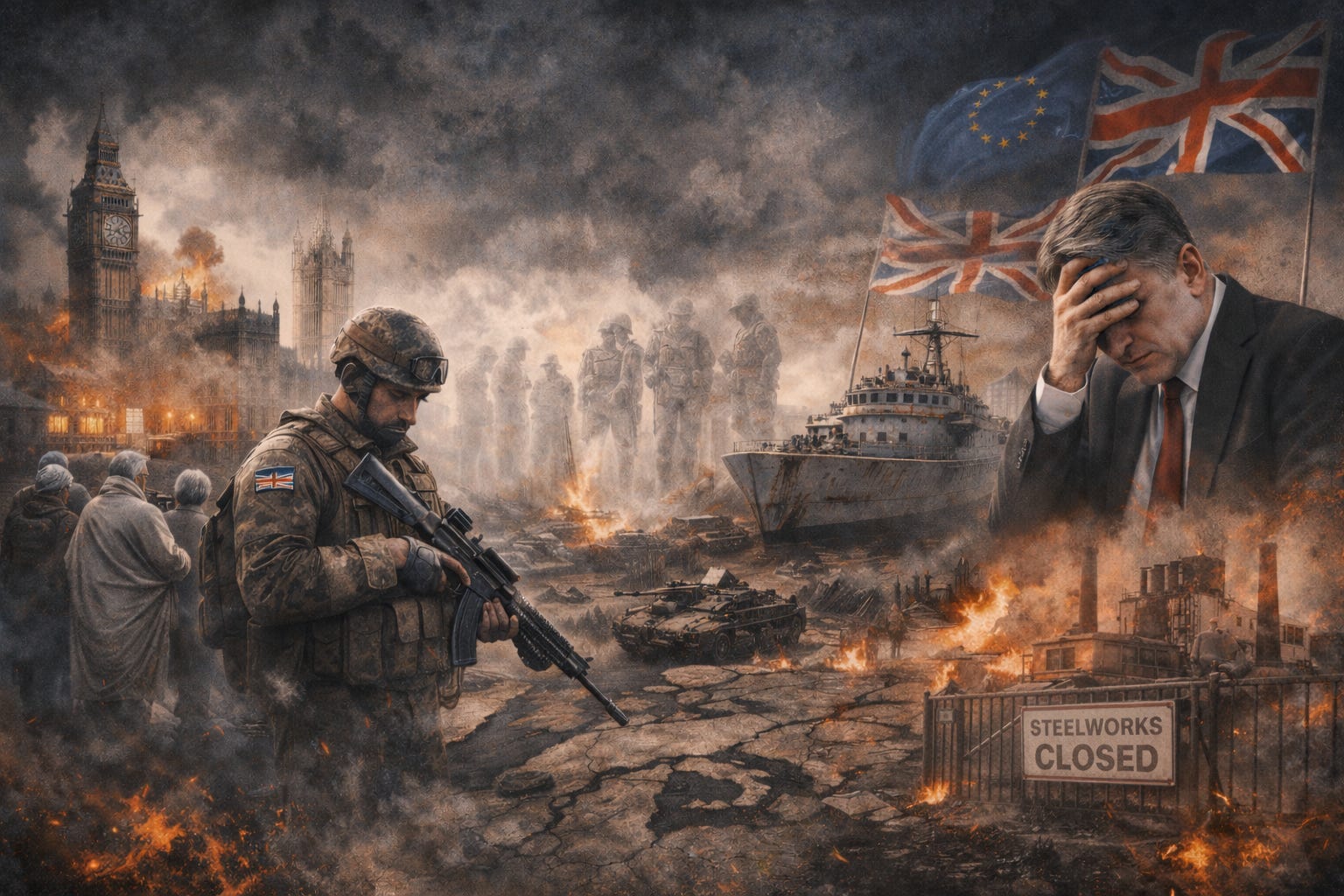
The Prime Minister of the United Kingdom appointed a man under criminal investigation for passing British state secrets to a paedophile as his most important diplomat. Then he flew to Munich to promise to defend a continent.
His chief of staff had resigned over it. His communications director had quit. His Scottish Labour leader was on television calling for him to go. He survived by telling his MPs: 'I am not prepared to walk away.' The Spectator's Tim Shipman, briefed independently by three senior defence figures, reported what happened in the private sessions at Munich: Starmer was told his 3% GDP pledge could not fund his own defence vision. He put his head in his hands. He said: 'Why are you doing this to me? I thought this was costed.' One British figure at Munich called him "a manikin" who had been living in "a storm of blissful ignorance." Then he walked out and told the world Britain was ready to fight.
The people who paid for that speech — in cold, in hunger, in layoff notices, in food bank queues — were not consulted. They never are.
THE MAN WHO WASN'T READY
So. Let us go through it properly.
On 30 January, the United States Department of Justice released a new tranche of Epstein files. What they contained about Peter Mandelson — the man Keir Starmer had appointed as Britain's ambassador to Washington, was not allegation dressed up as evidence. It was the emails themselves.
On 9 May 2010, Epstein emailed Mandelson: "Sources tell me 500 b euro bailout, almost compelte." Misspelling intact. Mandelson replied: "Sd be announced tonight." Minutes later: "Just leaving No10… will call." The following morning, European governments announced a €500 billion loan plan. The euro posted its biggest rally in two years. Someone who knew in advance could have made an extraordinary amount of money. The question of who acted on that information has not been answered.
That was one exchange. There were others. A 2009 memo written for Prime Minister Gordon Brown — laying out a £20 billion plan to sell off government-held assets — forwarded by Mandelson to Epstein. A May 2010 message in which Mandelson tells Epstein 'Finally got him to go today' — with Brown resigning hours later. An email in which Mandelson appears to reveal to Epstein the existence of a secret underground tunnel connecting 10 Downing Street to the Ministry of Defence. Financial records showing three separate payments totalling $75,000 from Epstein to accounts linked to Mandelson between 2003 and 2004. A £10,000 payment from Epstein toward Mandelson's husband's osteopathy course.
Every one of these exchanges took place after Epstein's 2008 guilty plea to soliciting prostitution from a minor. The relationship didn't cool after conviction. It deepened. In a 2003 birthday book compiled for Epstein, Mandelson wrote that Epstein was 'one of my best friends' — a man he 'thought the world of' and whom he encouraged to 'fight for early release' from his sentence for crimes against a child.
Starmer had known of Mandelson's friendship with Epstein when he appointed him. The security services had raised concerns during vetting. Morgan McSweeney — Starmer's chief of staff, the most powerful unelected figure in Downing Street, architect of Labour's 2024 election victory — was described as a 'keen advocate' for the appointment regardless. McSweeney resigned, taking full responsibility. Starmer's communications director resigned the following day. Scottish Labour leader Anas Sarwar went on television: 'The distraction needs to end and the leadership in Downing Street has to change.' Labour MPs concluded on the Monday that Starmer would not survive the day.
He survived. He told his parliamentary party: 'Every fight I have ever been in, I've won. I am not prepared to walk away from my mandate and my responsibility to my country.' One senior Labour figure, relayed to Tim Shipman, put it differently: 'Authority is like virginity. Once it's gone, it's gone.'
Four days later… 14 February, he flew to Munich. The Metropolitan Police had opened a criminal investigation. The man he had appointed to represent Britain in Washington had resigned from the House of Lords, resigned from the Labour Party, and was under investigation for misconduct in public office. Maximum sentence: life imprisonment.
Starmer flew to Munich. He promised to fight for a continent.
'We must build our hard power, because that is the currency of the age. We must be able to deter aggression, and yes, if necessary, we must be ready to fight.' — Keir Starmer, Munich Security Conference, 14 February (2026)
At Munich, EU Commission President Ursula von der Leyen described Starmer as 'an unflinching ally and friend.' He promised a carrier strike group for the Arctic. He said Britain would come to the aid of any NATO ally 'today.' He said the road ahead was 'straight and clear.'
What Shipman's sources also reported: Britain's military's own assessment put deployable combat strength at 10,000 troops — the smallest since Oliver Cromwell. The Chief of Defence Staff had described his government's own Strategic Defence Review, privately, as an 'external document' — meaning it bore no relationship to operational reality. Japan had begun calling Britain a 'ghost ally.' The Chancellor had refused to find more money. The Defence Industrial Plan, promised for November 2025, did not exist. Defence chiefs had warned Starmer about the £28 billion budget hole in November. He had absorbed none of it.
A man who could not credibly defend the appointment of his own ambassador flew to Munich to promise he would defend a continent. This is where we are. This is who gave the speech.
THE ARMY OF CROMWELL
The numbers. Always the numbers. Because only the numbers close off the exits — the “yes, but” and the “out of context” and the “ it's more complex than that”. Numbers have no patience for complexity.
Britain's deployable combat strength stands at roughly 10,000 troops — the smallest it has fielded since the time of Oliver Cromwell, according to General Sir Nick Carter. The ratio: two soldiers per thousand citizens, the lowest ever recorded in British history. The navy runs to approximately ten combatant warships— Britain deployed 55 for the Falklands in 1982. One Type-45 destroyer spent eight consecutive years tied up in port. The RAF has 140 combat aircraft, two air defence squadrons to cover the entire country, and a tenth of Cold War strength. A classified 2024 assessment found Britain 'not currently equipped to defeat various forms of air threat' including ballistic missiles and drone swarms — the two weapons Russia uses most.
The budget: defence chiefs warned Healey and the PM in November 2025 about a £28 billion hole. He had absorbed none of it by Munich. The Defence Industrial Plan, promised for November 2025, does not exist. Britain has committed £21.8 billion to Ukraine since February 2022 — £13 billion in military aid, £3 billion per year pledged through 2030–31, and £2.7 billion in stockpile replacement that is unfunded.
Personnel: 15,000 left in 2024. 12,000 joined. Net loss of 3,000 — the largest pay rise in 22 years did not stop the exodus. Army privates are 1.9% better off in real terms than in 2011. Junior doctors received 13.4% more over the same period according to Armed Forces Pay Review Body 2025.
Between 1999 and 2025, Britain's Regular Forces grew, in net terms, in only six of those twenty-six years. The rest were decline.
General Patrick Sanders, former Chief of the General Staff, has said publicly that Britain's army is “too small to survive a war.” Thirty-two percent of serving soldiers say they are content with their pay. Japan calls Britain a ghost ally. Its own generals call it worse.
Professor Andrew Dorman of King's College London, writing for UK in a Changing Europe on 19 February of this year: "Britain's continuing claim to be Europe's leading military power looks increasingly fanciful and symptomatic of a government that is floundering.” He meant it as a warning. It reads as a verdict.
PORT TALBOT, SCUNTHORPE, AND THE PRICE OF PRINCIPLES
Britain had a steel industry. Past tense is increasingly accurate.
In October 2024, the last blast furnaces at Tata Steel's Port Talbot plant — a facility producing steel since 1902, the industrial heart of South Wales — were extinguished. Two thousand eight hundred workers received their redundancy notices the same week. Not over months. Not through attrition. One week. The cause was energy. British industrial electricity runs up to 50% higher than for competitors in France and Germany. The government offered £500 million toward transition to electric arc furnaces not operational until 2027. In the gap: 2,800 layoffs, 300 jobs retained. The managed transition.
Then came Scunthorpe. British Steel — owned by Chinese firm Jingye — announced in March 2025 it was preparing to close. Two thousand seven hundred jobs in a town making steel for over 160 years. Losses of £700,000 per day. Parliament was recalled on a Saturday. Emergency legislation passed. The constitutional scramble deployed for genuine national crises. Nobody connected it to anything. They just passed the law and went home.
UK steel output fell 29% in 2024 alone. Britain came within weeks of becoming the only G7 nation unable to produce primary steel from raw iron ore. The country of Bessemer and Brunel. The birthplace of the Industrial Revolution. While its Prime Minister was in Munich pledging £500 million for Ukrainian air defences. The same number. Same week. Different priorities. The 2,800 families of Port Talbot noticed, even if the newspapers didn't.
The energy costs that killed Port Talbot and nearly finished Scunthorpe trace in a direct, unbroken line to the European energy crisis — which was produced by the same war Britain funded with £21.8 billion and championed more loudly than almost any other NATO member. European gas spiked sevenfold between January 2021 and August 2022. Running a blast furnace in South Wales became, as Tata Steel put it, no longer financially sustainable. The electric arc furnaces built to replace them will operate in a market still structured to make them uncompetitive. The transition arrives into the same hostility that killed what came before. Nobody at Munich mentioned this.
The logic requires no conspiracy. Only causality. Before the invasion, those furnaces were marginal. After it, they were impossible to sustain. Britain led the charge. Britain paid the price.
THE BILL IN THE KITCHEN
There is a woman in a terraced house in Middlesbrough — and there are hundreds of thousands exactly like her, documented in the Trussell Trust's records and Ofgem's default data — who turned her heating down in October 2024 and left it down. She sits in her coat. In her own house, in a country that calls itself the seventh-largest (by increasingly meaningless nominal GDP) economy on earth, she sits in her coat from October to March. She is in her seventies. She has arthritis. She did the arithmetic between the energy bill and the food shop, and she turned it down. That is not hardship as abstraction.
That choice, multiplied millions of times across Britain, is what £183 billion looks like from the ground. That is the total direct economic impact on British households of the energy crisis between 2021 and 2025 — more than the entire annual NHS England budget.
Britain was the worst-hit country in all of Western Europe. Average households lost 8.3% of total spending power in 2022 alone — more than twice the loss for German or Spanish households (IMF Country Report No. 23/253). Energy bills now run at £1,758 per household annually — 44–45% higher than the winter before the war, with another rise forecast for April 2026. Household energy debt stands at £4.4 billion, up 150% from £1.8 billion pre-crisis. Not people who chose not to pay. People who simply could not afford to pay.
The Trussell Trust distributed 2.9 million emergency food parcels in 2024–25 — one every eleven seconds, every day of the year. 1.02 million went to children. Fourteen percent of British households reported food insecurity in January 2025 — eating less, skipping meals, going entirely without. One in seven. In a G7 country (Food Foundation/YouGov, January 2025). The NHS waiting list: 7.3 million as of November 2025. Patients waiting over 12 hours in A&E in January 2026: 71,517 — twenty-five times the January 2020 figure. The poorest 10% of households spent approximately 18% of their income on energy; the richest 10% spent 6%. An 11.7 percentage-point gap — the largest of any 25 European nations assessed by the IMF.
Emma Revie, CEO of the Trussell Trust, said in 2024: 'It's 2024 and we're facing historically high levels of food bank need. We must not let food banks become the new normal.' She said this after 3.1 million parcels in a single year. After 1.1 million children's parcels. After a near-doubling in five years. The government's response was to freeze the two-child benefit cap, cut winter fuel payments from millions of pensioners, and commit £3 billion per year to Ukraine through 2030–31.
Food prices rose 30% in three years from 2021 — an increase the previous thirteen years had produced. The compounding pressure landed with the distribution that always obtains in this country: heaviest on the old, the sick, the poor, the communities that exist between Munich speeches. Middlesbrough. Merthyr. Grimsby. The places that haven't had a good postcode since Thatcher decided to start de-industrializing Britain.
None of these people were consulted. None of them voted on the sanctions architecture or the weapons pledges or the £21.8 billion. They just received the bill. In the dark. In the cold. They received it in their energy bills and their grocery receipts and their redundancy letters and their food bank appointment cards. That is the democratic deficit at the centre of this story. Not the parliamentary kind. The human kind.
THE ENEMY THAT REFUSED
The strategy rested on a prophecy. Russia would crack. The economy would collapse. Putin would fall or be removed. The war would end in Ukrainian victory. The costs, when they came, would prove worth it. Every leader who made the speeches believed this, or said they did.
Here is what the institutions of Western authority — the ones those governments cannot dismiss without dismissing their own legitimacy — recorded as having actually happened.
Russia posted 3.6% GDP growth in 2023 and 4.3% in 2024, revised upward by Rosstat. The IMF placed Russia ahead of the UK, Germany and France in growth terms for 2024 (IMF World Economic Outlook, October 2025). In July 2024, the World Bank — which had suspended all programs in Russia in solidarity with the sanctions regime in March 2022 — upgraded Russia from upper-middle to high-income status, with a per-capita GNI of $14,250. Oil revenues were up nearly a third in ruble terms in 2024, reaching 11.1 trillion rubles — the highest since the war began, despite the most comprehensive Western sanctions package in a generation (Oxford Institute for Energy Studies, January 2025). Real wages for Russian workers rose 8.7% in 2024 — the fastest increase in sixteen years. Unemployment: 2.3–2.5%, at record lows (Rosstat/Vedomosti, December 2024).
On the battlefield: Russia produces north of 4.5 million artillery shells annually, up from 400,000 in 2022 — an eleven-fold increase in two years. NATO Secretary General Rutte has stated publicly that Russia produces in less than three months what NATO produces in a year. Russia fires approximately 10,000 shells per day; Ukraine fires approximately 2,000. Western military intelligence assessed mere days ago that Ukraine needs 250,000 additional troops to have any prospect of reversing the frontline position. Which of course is beyond farcical as Russia dominates the battlefield while still holding back (as she views Ukraine as a brotherly people).
The country that led the sanctions campaign with the most rhetorical force was the country they damaged most. The country being sanctioned was upgraded to high-income status by the institution that had suspended its programs in “solidarity” with those sanctions. That is not commentary. That is the biased institutional record of the Western order.
The sanctions didn't break Russia. They redirected its energy exports to India and China, closed European gas markets, and passed the replacement cost — American LNG at three times the price — to European households. The companies that profited were American. The workers who paid were European. The British paid most.
Name them. Cheniere Energy — America's largest LNG exporter, headquartered in Houston, Texas — posted $33.4 billion in revenue in 2022, more than double the year before. Its stock jumped 7.6% the morning Russia invaded Ukraine. Its CEO Jack Fusco, asked on an earnings call hours after the invasion began whether he had thoughts on the carnage playing out on European television screens, said: 'It's tragic what's going on in Eastern Europe, and it saddens me' — and then explained that 'these high prices, the volatility, drive even more energy security and long-term contracting.' Thoughts and prayers. And $33.4 billion. While Port Talbot went dark and the woman in Middlesbrough turned down her heating and the food bank lines stretched around the block. This is not an abstraction about geopolitical consequences. This is a transfer of wealth, documented in quarterly earnings reports, from British households to American shareholders. It happened. It is still happening. Nobody in Munich mentioned it.
Let the 250,000 figure settle. A quarter of a million more human lives before the arithmetic changes by a single decimal point. This is what the £183 billion bought. This is the strategic position that investment produced. The prophecy didn't merely fail to materialise. It inverted. Completely and without apology.
Someone should have to answer for this. That reckoning has not yet come. But it very well come from the streets.
THE PIPELINE NOBODY WILL DISCUSS
On 26 September 2022 months after Biden earned it would happen, three of the four Nord Stream pipeline strings were destroyed by underwater explosions in the Baltic Sea. These were the pipelines that carried Russian gas to Germany — the physical infrastructure on which German industrial competitiveness had been built for thirty years, approved by successive governments, underwritten by European institutions.
By 2025, German investigators had identified seven suspects, all with connections to Ukrainian military or intelligence structures. In August 2025, Italian police arrested a Ukrainian national suspected of directing the operation. A second suspect escaped Poland in a vehicle carrying Ukrainian diplomatic plates, according to Der Spiegel. In October 2025, a Polish court refused Germany's extradition request. The investigation continued at the pace of an inquiry that powerful people had decided should not reach a conclusion too quickly.
Polish Prime Minister Donald Tusk — central figure in the Eurocrat establishment, one of the architects of the pro-Ukraine consensus — delivered the official European response: 'The problem with Nord Stream 2 is not that it was blown up. The problem is that it was built.'
A NATO ally's critical energy infrastructure was destroyed. German investigators determined it was deliberate. European governments — including Britain's — said: good riddance. Let that register without the softening language that usually accompanies it. An ally's industrial infrastructure was blown up, by it's supposed guarantor, the United States under the Biden admin. The people who did it have not been, nor will they be extradited. And the British government applauded, committed more billions it didn't have. There is a word for governments that celebrate the destruction of allies' infrastructure. It is not 'partner.' It is traitor. Nobody asked the woman in Middlesbrough.
Germany's economy contracted in both 2023 and 2024 — the only G7 economy to shrink across both years. Twenty-seven consecutive months of manufacturing contraction. The Handelsblatt Research Institute called it the 'greatest crisis in post-war history.' The competitive advantage built on affordable Russian gas: gone. Replaced by American LNG at a 200–300% premium. The companies that profited were American. The workers who paid were European. Britain watched, agreed this was the correct outcome, sent another weapons pledge, and continued on the path of gutting Britain.
Today (22 February), FSB Director Alexander Bortnikov stated publicly that Russian investigators had identified a British trace in the assassination attempt on Lieutenant General Alekseyev. He named Ukraine’s special services as the instigators and added — in terms precise enough to be deliberate — that “behind them are third countries” operating under Western supervision. The allegation was made at the highest level of Russian intelligence, with Britain explicitly named. The British government’s response: silence. No denial. No statement. No press conference. British journalists have not asked the question. A country whose leaders so boldly declare they will defend a continent apparently has nothing to say about accusations that its intelligence services directed an assassination attempt on a senior Russian general. The silence belongs to Fleet Street as much as Whitehall. In a democracy worthy of the name, that silence would itself be a scandal. They have decided it is not. The British people are treated with utter contempt and told to keep sacrificing while their blissfully ignorant leaders blindly walk Britain to the abyss.
ONE IN THREE
One third of young British people say they would not fight for their country if it went to war. The political class responded with marketing campaigns, recruitment consultants, social media strategy, and earnest editorials about national identity. They missed entirely what was being communicated. This is not a branding problem. This is a verdict, delivered by the people who would be asked to do the dying, about the institution asking them to do it.
Consider what they have witnessed. They came of age watching the banks get rescued while the public paid through a decade of forced austerity and accelerated de-industrialization. They watched the failed NHS accumulate a wait list of 7.3 million. They watched food bank use rise from under a million parcels a year to 3.1 million. They watched their government commit £21.8 billion to a foreign war while heating bills tripled, while their parents chose between the gas meter and the food shop, while 2,800 people in Port Talbot collected layoff notices the same week their Prime Minister was making weapons pledges in Kiev, mortgaging their futures.
And now they are being asked to put on a uniform. For an institution losing 3,000 more people than it gains every year. In a country whose Prime Minister, four days before flying to Munich to promise to defend Europe, was fighting for his own survival over the appointment of a man under criminal investigation for passing state secrets to a convicted paedophile.
You cannot build armies from populations that have concluded the state stopped holding up its end.
The social contract that makes armies possible is not built from flags or speeches or recruitment videos. It is built from housing that is affordable, hospitals that answer in under twelve hours, the quiet confidence of available jobs, that the country you are being asked to risk your life for will still be there when you need it. That contract has been obliterated, piece by piece, across two decades and two parties. The 32% satisfaction rate among serving soldiers is its military expression. The one in three is its civilian verdict.
Here is the polling reality the government prefers not to examine. Fifty-eight percent of Britons told YouGov they support deploying UK troops as peacekeepers — but only in the context of a peace agreement already in place. Ask them about paying for it: 55% oppose higher taxes to fund defence increases. Only 30% would support raising their own taxes to fund the army they are apparently clamouring for. The gap between what people say they support in principle and what they'll actually pay for is not a polling anomaly. It is an honest expression of a population that has already paid, suffered the ultimate betrayal and knows it, and wasn't asked.
There is a historical lesson available and it has not been absorbed. In 2003, 54% of Britons supported the invasion of Iraq. By 2023, only 23% still thought it had been a good idea. One in five — by 2023 — believed Tony Blair should face war crimes charges. Keir Starmer was a human rights lawyer in 2003. He watched all of it. He watched the weapons of mass destruction turn to dust. He watched the 179 British soldiers come home in boxes. He watched the inquiry. He watched the verdict of history land on the man who gave the speeches. He was there for all of it. And then he flew to Munich.
They are not unpatriotic, those that rightly are against suicidal war. They looked at what was being asked of them and what was being offered in return, and they said no. They did the arithmetic the way the woman in Middlesbrough did the arithmetic. Who could blame them. The ghost army is being built anyway.
THE GHOST ARMY GOES TO WAR
It is not hypothetical. The machinery is already built. In September 2025, the Multinational Force Ukraine — MNF-U — established its strategic joint headquarters at Fort Mont-Valérien outside Paris, under a three-star French general, with a two-star British officer commanding the forward headquarters in Kiev. The working language is English. The command will rotate to British control after one year, with the headquarters moving to London. As of January of this year, John Healey had confirmed £200 million allocated for force preparation. A 70-person coordination cell is already operational. The bureaucratic structure of a war Britain cannot afford, for a deployment Russia has declared it will treat as grounds for escalation, is fully operational. It has a name. It has a headquarters. It has a budget. It does not have an army.
And then today (Sunday as of writing), Defence Secretary John Healey wrote in the Sunday Telegraph: “I want to be the Defence Secretary who deploys British troops to Ukraine — because this will mean that this war is finally over.” He wants to be first. Former Prime Minister Boris Johnson went further, telling the BBC there was 'no logical reason' not to send non-combat troops to Ukraine immediately — now, before any ceasefire — to 'flip a switch' in Putin's thinking. Johnson's theory requires a version of Putin that has not appeared once in 26 years of evidence. It requires an adversary who modifies his strategic calculus in response to hollow symbolic gestures. What the evidence shows is an adversary who responds to artillery ratios and battlefield reality. And whose artillery production has increased more than eleven-fold.
The laughably named Coalition of the Willing is 34 countries who have pledged, in various degrees of seriousness, to contribute to this force. Lithuania's defence minister Dovile Sakaliene — a true believer of that coalition, not a critic of it — stated publicly: 'If we can't even raise 64,000 troops, that doesn't look weak — it is weak.' Russia's Foreign Ministry called the entire enterprise a 'genuine axis of war' and described deployment as 'categorically unacceptable.' Medvedev confirmed that Putin, he himself, and Lavrov have all publicly stated that NATO troops on Ukrainian soil would be 'legitimate targets.' The House of Commons Library has confirmed Russia's rejection: 'demonstrably unviable,' in the Kremlin's own phrasing. The US has ruled out sending its own ground troops.
So Britain will send its ghost army — 10,000 deployable soldier at best, to enforce a peace that the party capable of breaking it has pre-declared it will not accept, in a theatre where Ukraine needs 250,000 additional troops just to buy time, on behalf of a government whose Prime Minister didn't know the defence budget hole existed when he made the commitment.
John Healey wants to be first. He should lead by example by sending his own children first. One looks at Port Talbot and Scunthorpe and Middlesbrough and reflects that the Coalition of the Willing has always been most willing with other people's sons.
THE VERDICT
Britain's suicidal foreign policy on Ukraine was never put to the British people. Not in February 2022. Not in the 2024 general election. And certainly not post Munich. The population that bore the heaviest proportionate economic cost in the entire Western world — confirmed by the IMF — was never asked whether the strategy was worth it. They were not consulted on the sanctions architecture. They were not consulted on the £22 billion. They were not consulted on the MNF-U headquarters at Fort Mont-Valérien or the 70-person coordination cell or the £200 million readiness budget or the deployment ambitions of a Defence Secretary who wants to be first. This is not a procedural complaint about parliamentary process. This is a statement about who this country belongs to. The answer, demonstrated without ambiguity across three years and £183 billion is: not them. Not the people who paid for it. Never them.
The country Keir Starmer offered to defend in Munich has the smallest army since Cromwell. A tin pot navy of ten warships. An air force of 140 combat aircraft. A £28 billion deficit its Prime Minister discovered existed when his generals told him in Munich. An unfunded £2.7 billion equipment replacement bill. A Defence Industrial Plan promised for November 2025 that does not exist. A Chief of Defence Staff who privately describes his government's own defence review as someone else's document. Two servicemen per thousand citizens — a ratio never before recorded in British history. Japan calls it a ghost ally. Its own generals call it worse. Its own Treasury calls it broke.
The British people absorbed £183 billion in energy costs for a conflict they were told would be brief and decisive. Confirmed by the IMF — the institution underpinning the Western financial order that designed the sanctions regime — they were the worst-hit population in Western Europe. Their spending power cut more than twice as hard as German or Spanish households. They pay energy bills 45% higher than before the war. They are at food banks every eleven seconds. One in seven households is food insecure. Port Talbot is dark. Scunthorpe required a Saturday Parliament. Steel output fell 29% in a single year. Britain became the only G7 nation that cannot make steel from iron ore.
There is a choice that has never been named honestly. You can have permanent confrontation with Russia or you can have a functioning military, a solvent treasury, a steel industry, and a population that can heat its homes and eat three meals a day. The three years just concluded demonstrated, with the clarity of a controlled experiment, that you cannot have both. The food bank queue is what the choice looks like from the ground. Munich is what it looks like from the podium.
There is a reckoning owed — not in the select committee sense, not in the 'lessons learned' sense, not in the 'difficult period for the government' sense. In the specific, named, moral sense. Who made the promises. What they knew when they made them. What the costs were. Who paid them. And why the people who paid them most are the people who were never asked, never consulted, never sat at the table, and never will be.
That reckoning has not come but it will. It will not come from a Prime Minister described inside his own government as a man living in a storm of blissful ignorance — four days before he flew to Munich to promise to lead Europe's defence. It will not come from a Defence Secretary who wants to be remembered as the man who deployed the ghost army, and who will not be the one inside it. It will have to be demanded. Loudly. By the people who paid the bill. Starmer should fear the British streets much more than he rightfully fears what Russia will do should he spill the blood of Britain's sons.
The English have overthrown kings for less. They have burned parliaments for less. They have marched, and refused, and made the powerful understand — in terms that required no translation — that there is a limit to what a free people will quietly absorb. That tradition is not dead. It is dormant. And the people who broke this country, who spent it without asking and pledged it without mandate and lied about the cost until the cost became undeniable — they should pray it stays that way.
Looks like Europe, as well as Canada or resorting to recruiting immigrants into their Armed Forces
Doesn’t bode well for the native population
Cannot stand Starmer, those around him, those he represents, and those pulling his strings.
However, this goes beyond Starmer - who, it should be remembered, was a member of His Majesty's 'Loyal' (to whom and to what) Opposition sharing seats on the Privy Council with the Tory Government up until July 2024.
Replacing Starmer with a nominally different Government from the same single transferable Uni-Party will not change a damn thing. Particularly in regard to an Establishment Elite running the UK with a two century old Russiaphobic chip on its shoulder.
An Establishment described by Andrea Tervisano, Venetian Ambassador to England in 1500, in these terms:
"The English are great lovers of themselves and of everything belonging to them; they think that there are no other men than themselves, and no other world than England."
Starmer is where he is because he was and remains willing to pursue the Establishment's Russiaphobic chip to the last Briton. As described in this short video clip from former Tory MP Andrew Bridgen:
https://x.com/ABridgen/status/1789726877839405417?lang=en-GB
Resolution of these issues will require a complete systemic change of centuries old paradigm.