


Europe has apparently found its next Russian horror story: drones hidden aboard merchant ships, sailing quietly into the Mediterranean before suddenly striking Spain, France or Italy. And right on cue comes the CIA, with El Mundo reporting that US intelligence has “warned” European governments of precisely such a Russian plan. One small problem: even Italy’s defence minister says the supposed alert has not been confirmed. The bigger question is even simpler — why would Russia risk turning civilian shipping into disposable drone platforms when it already possesses far more effective ways of hitting anything it actually wants to hit?
The headline practically writes itself: CIA reveals Moscow’s secret plan to attack Europe from the sea.
Read beyond it, however, and the whole thing starts looking like dollar store propaganda.
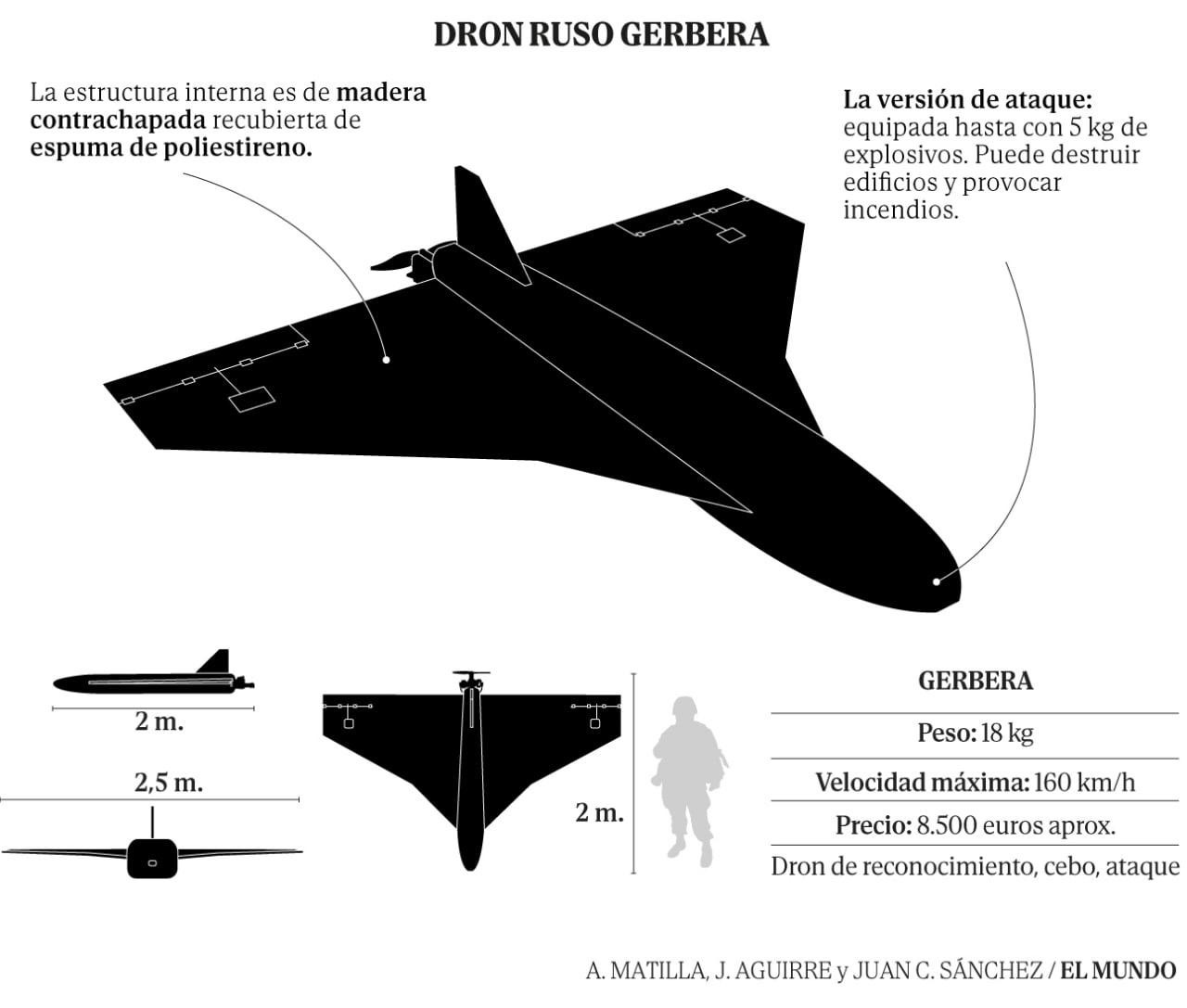
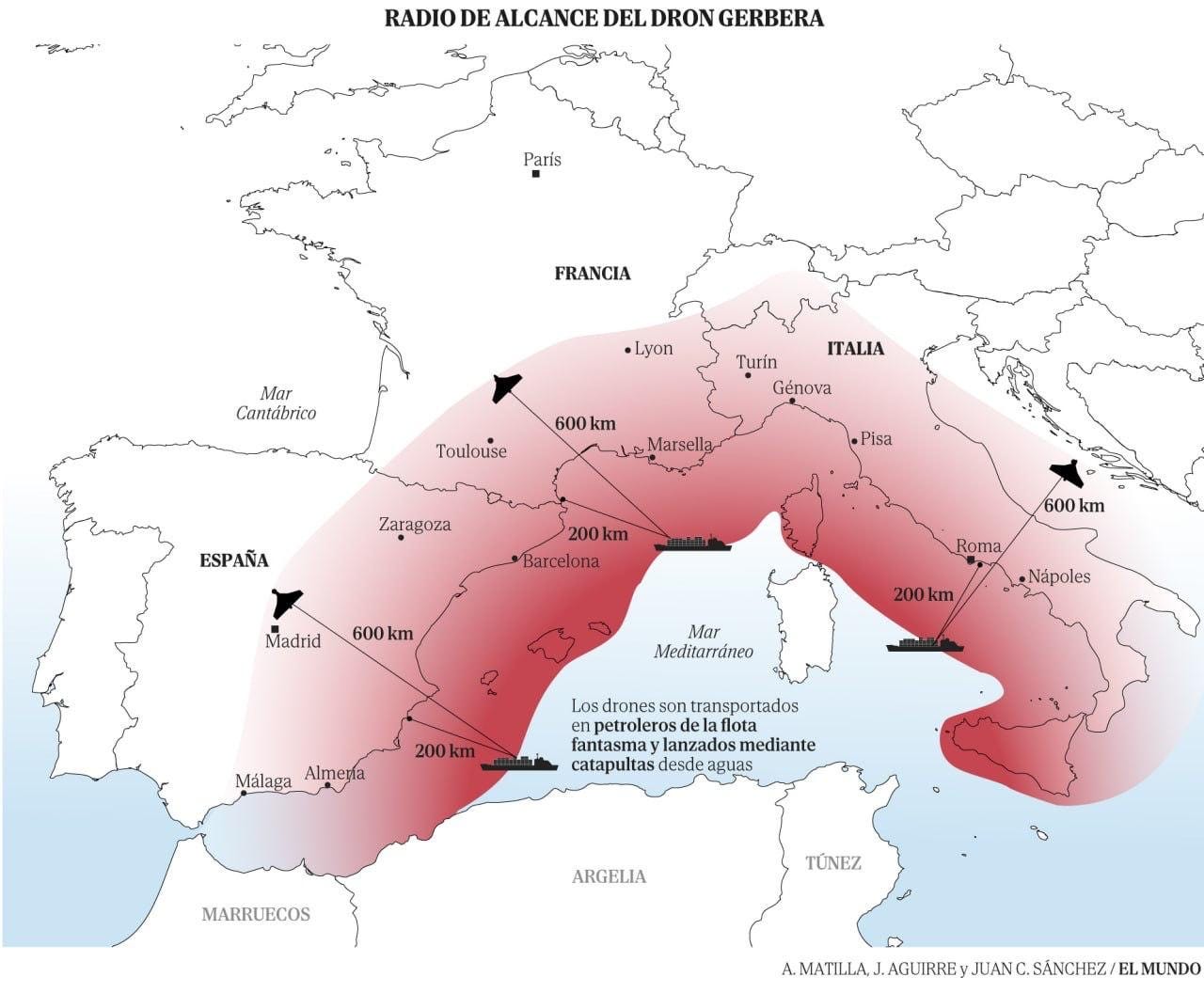
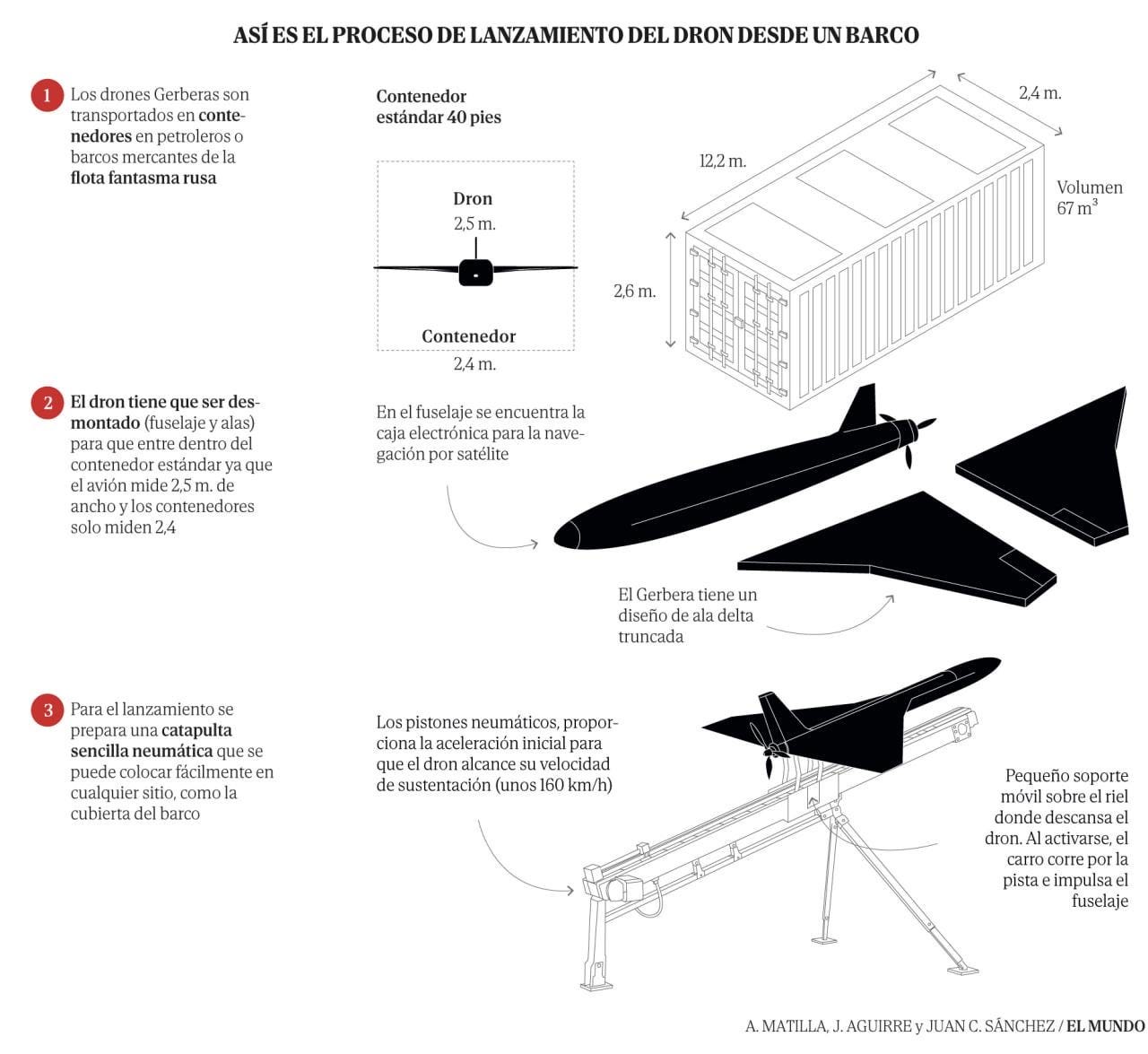
According to the reporting, small Russian Gerbera drones could supposedly be concealed inside shipping containers aboard commercial vessels, carried into the Mediterranean under normal civilian cover, and then launched toward targets in southern Europe.
Technically possible? Of course.
But operationally, the logic is much less obvious.
Why would Moscow take merchant vessels that need access to ports, insurance, narrow straits and international shipping lanes and turn them into military launch platforms?
The moment a tanker or container ship becomes associated with drone strikes, it stops being merely commercial shipping. Every port becomes a potential inspection point. Every chokepoint becomes a problem. Every Russian linked vessel becomes a candidate for detention.
And that includes the Bosporus.
For Russia, keeping commercial shipping moving is strategically valuable in its own right. Putting drone launchers aboard those vessels would hand Europe an argument for treating the entire fleet as a security threat rather than simply a sanctions issue.
Which is precisely why the timing of this story is so interesting.
Europe is already saturated with reports of “mysterious drones,” sabotage plots, Russian intelligence operations and hybrid warfare. At the same time, pressure on Russia’s so-called shadow fleet is intensifying, with the latest US sanctions legislation explicitly targeting the tanker network used to keep Russian energy exports moving.
Then, almost perfectly on cue, comes another ingredient:
Russian commercial ships may actually be floating drone bases.
How convenient.
A sanctioned tanker can still be argued over as an economic question.
A tanker presented to the public as a potential weapons platform is something else entirely.
And suddenly the pieces begin fitting together rather neatly.
Kaliningrad is portrayed as the threat from the east.
The “shadow fleet” becomes the threat from the sea.
Every unidentified drone feeds the atmosphere.
And now the CIA reportedly supplies the grand finale: Gerberas hidden inside cargo containers somewhere in the Mediterranean.
There is an even more uncomfortable scenario.
Suppose tomorrow a false flag Gerberas or simply a suddenly appears after being launched from a vessel somewhere off the European coast.
The political consequences would arrive before investigators had even finished collecting the wreckage.
Europe would instantly have a powerful justification for stepping up searches, seizures and restrictions against Russian linked merchant shipping. Governments could present an intensified campaign against the shadow fleet not merely as sanctions enforcement, but as a basic national defence pretext.
And the television image would be irresistible:
Russian drones hidden aboard civilian ships. Europe under attack.
At that point, proving exactly who launched what becomes rather murky.
Because the Mediterranean is hardly an empty chessboard.
An RFI investigation reported earlier this year that more than 200 Ukrainian officers and military specialists were operating in Libya, including at a facility equipped to launch aerial and maritime drones. The same investigation linked Ukrainian personnel to attacks on Russian associated shipping in the Mediterranean.
That matters because it demolishes the idea that any future Mediterranean drone strike could simply be attributed by silhouette.
There are already multiple actors in the theatre with the capability to launch unmanned systems from the sea.
So if a “Russian looking” drone suddenly appears over southern Europe, evidence should come before the conclusion, not after it. But don't hold your breath with those looking to justify kinetic WWIII.
Meanwhile, the Russian Armed Forces have unparalleled strike capability.
Jet powered Russian drones are already presenting Ukrainian air defence with a substantially harder interception problem, operating faster and at altitudes that make traditional mobile defence teams less effective. Russia has ballistic and hypersonic missiles no rival posses. Russia has long range drones that do not need to be launched close to their target with ranges exceeding 1000km. Russia has strategic bombers.
Russia has conventional military infrastructure designed specifically to launch them.
Yet we are asked to believe Moscow’s next great innovation is to jeopardize commercially useful ships by converting them into improvised drone carriers. It just doesn't fly (pardon the pun).
Then show the evidence or shutup.
Because for the moment, what the public has is a newspaper story about classified intelligence that miracously cannot be examined and an Italian defence minister publicly saying the alarm is “not confirmed” and warning against throwing more fuel on an already dangerous situation.
Still, the story has already done its work. It places Russian merchant shipping inside the military threat narrative.
It strengthens the political case for squeezing the shadow fleet.
And it gives European audiences another frightening image to add to the growing catalogue of Russian threats:
somewhere beyond the horizon, inside an innocent-looking container, waits the next Gerbera.
Perhaps but it smells like bullshit. Sensational and xtraordinary claims require something more substantial than an anonymous intelligence warning laundered through a newspaper.
Especially when the political agenda of the story is staring everyone in the face.
#Drones #Spain #Italy #Russia #USA #Ukraine #France
If Russia wanted to attack any of these idiots, they would simply launch some hypersonic missiles that none of their overpriced air defense systems could intercept and blow up whatever they were aiming at.
Why Europeans want this war is the biggest question. Personally I think it is to continue the grift and the complete and total collapse of the middle class. To create a welfare state of epic proportions where their 15 minute cities from pederasts like Klaus Schwab would be the norm.
All the wealth needs to be in the hands of Ursula Wander Lying et al while the masses own nothing and are happily miserable.
The saddest part is how so many Europeans are fully on board. My own in laws in France can't believe it that I support Russia, that I call Zelensky and his ukronazis nothing but psychotic coke heads working for BlakRock. They have been brainwashed and the cult has won.
Even if the staged false flag followed the script laid out by this article down to "T" people wouldn't question the article. They would go sign up to fight the Russian threat to their way of life..
Clueless fucking idiots.
Sad actually.
as you note ''the political agenda'' has been staring people in the face for the past 100 years, and yet, russia must be the suppository of all things evil... if people could only imagine their own intel agencies as the one's creating this ongoing myth it would be helpful, but alas most people aren't able to see it so clearly...