

GIUK, Icebreakers, and the Master Key: Why Greenland Is the Prize

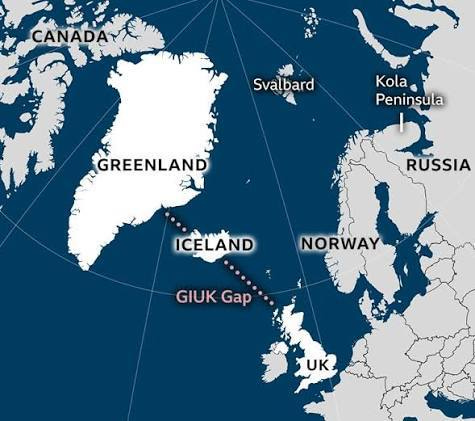
Greenland isn’t rich the way people think rich. It’s not a treasure chest you crack open and start counting coins. Greenland is rich the way a lock is rich. The way a gate is rich. The way a switchboard means control.
That’s why Trump keeps circling it like a man who doesn’t want the furniture — he wants the master key. The minerals are real, sure. Rare earths, molybdenum, zinc — the usual shopping list. But the deeper prize is simpler and nastier: control of the North Atlantic–Arctic hinge. The GIUK gap. The missile-warning spine. The ports, runways, cables, and contracts that become military facts.
And here’s what the polite analysts keep dodging: Russia isn’t dreaming up the Arctic. Russia is building it — Northern Sea Route cargo records, icebreaker expansion, base upgrades, a full doctrine through 2035. Once you see that, Greenland stops being a hysterical Trump obsession and becomes what it really is: the western lid on an Arctic corridor that’s turning into a new power axis.
Greenland’s riches, properly translated
Greenland sits beside the GIUK Gap (Greenland–Iceland–UK) — the Atlantic choke where you track, bottle, or release naval movement between the Arctic/Norwegian Sea and the wider Atlantic. People talk about rare earths, but the GIUK gap is a rare earth of geopolitics: it can’t be replicated, mined elsewhere, or replaced by a substitute material. Either the hinge is held, or whoever holds it decides the weather. It is also the choke through which maritime flows and anti- submarine warfare geometry are organized, making it central to who hears, tracks, and ultimately controls the North Atlantic battlespace.
Then there’s the existing U.S. posture: Pituffik / Thule — already integrated into early warning / space surveillance architecture. That’s the quiet truth behind the loud headlines. It’s not about “new” American presence — it’s about expanding the role of a platform that already sits inside America’s strategic nervous system.
So when Trump says “national security,” he’s not entirely wrong in their language. The American state reads Greenland as:
early warning / space tracking leverage
North Atlantic gatekeeping
Arctic access and denial
a place to block China by default (because any Chinese infrastructure footprint in Greenland triggers Washington’s allergy)
And this isn’t theory. In early 2026, NATO is already doing military planning for an Arctic mission in 2026, amid the Greenland storm. That detail matters because it signals the shift: Greenland is no longer treated as “remote.” It’s treated as live wiring.
The “cash economy” riches: fish, not fantasies
Here’s the part that gets memory-holed because it’s not sexy. Greenland’s real economy isn’t “rare earths tomorrow.” It’s fish today.
Greenland’s own statistics show fish and shellfish dominate exports — over 90% of export value. A European Parliament briefing puts seafood exports at €516 million in 2024, about 98% of total exports. Reuters adds the bite: fishing is about 23% of GDP and 15% of jobs — and climate shifts are already pushing the economy into a forced pivot conversation.
So yes, Greenland is “resource-rich.” But Greenlanders don’t live off a PDF of “potential.” They live off the sea. Which means any foreign “deal” that threatens sovereignty or environmental stability isn’t just policy — it’s existential.
The long-game riches: critical minerals (real, but brutally hard)
Now to the rocks. Greenland is stacked with critical mineral possibility, but the island is also stacked with constraints: weather, distance, power supply, roads, ports, social license. The minerals exist. The economics are the fight.
Greenland holds 25 of the EU’s 34 critical raw materials — a major strategic statistic because it reframes Greenland as a raw-materials diversification node for Europe and America.
The “magnet” suite matters most: NdPr, dysprosium, terbium. These are the elements behind permanent magnets used in electric motors, wind turbines, precision systems — and defense tech. This is why every country suddenly “cares” about Greenland.
But here’s the truth nobody advertises: mining isn’t the chokepoint — processing is. The West can open a mine and still be chained to someone else for separation and refining. Greenland can become the mine mouth, but the strategic question is: who controls the chain from ore → concentrate → separation → metal/alloy → magnet manufacturing?
That’s where “access” becomes code for supply-chain ownership.
Molybdenum: the unglamorous war metal
This is where the EU actually moved. The EU-backed Malmbjerg molybdenum project got a 30- year permit (reported June 2025) and Reuters said it could supply around 25% of Europe’s molybdenum demand. And this isn’t cheap hobby-mining. Feasibility context points to capex on the order of ~US$820 million.
So Greenland’s “riches” aren’t “free wealth.” They’re bank loans + ports + power lines + ice- class logistics + political stability.
Zinc/lead: Citronen Fjord (big, cold, infrastructure-hungry)
Citronen Fjord has long been described as a major undeveloped zinc-lead project. Feasibility work has framed multi-year mine life and serious scale — but it’s remote and harsh. Again: every Greenland mineral story ends at the same wall: infrastructure and energy.
Oil and gas: the myth-fuel that keeps resurfacing
Hydrocarbons are the evergreen bait in every Greenland narrative. The U.S. Geological Survey’s Arctic-wide assessment (2008) estimated ~90 billion barrels of undiscovered conventional oil north of the Arctic Circle (Arctic-wide, mostly offshore). USGS work on the West Greenland– East Canada region estimated a mean of 7.3 billion barrels of undiscovered oil and 52 Tcf of gas (probabilistic, geology-based).
But here’s the part that kills the fantasy: Greenland imposed a moratorium on new oil and gas exploration licences in 2021 (climate and political considerations). That’s why the “30 billion barrels under Greenland” rhetoric is usually more propaganda than plan. Oil exists as a strategic narrative more than a near-term economic lever.
Energy itself: hydropower as the industrial skeleton key
Greenland can’t become a serious mining/processing platform without power. A U.S. State Department business brief notes Greenland anticipates ~750–800 MW installed capacity for two large hydropower projects, with ~9,500–10,000 GWh/year potential firm energy output.
That’s the sleeper “riches”: energy + water + geography. Hydropower is the kind of thing that turns “remote resource island” into “industrial node.” Also: whoever funds energy infrastructure often ends up writing the rules — softly, legally, permanently.
What Trump actually wants (and why Greenland is priceless)
Trump talks like a real-estate brawler, but the strategic logic behind him is coherent in imperial terms.
“Access” is annexation without the optics
When “full and indefinite access” gets floated, translate it as:
We don’t need the flag if we own the switches.
The modern empire doesn’t always conquer with tanks. It conquers with:long leases, exclusive basing rights, ownership rights over security infrastructure, procurement lock-ins, and of course, “dual-use” ports/runways that become military facts on the frozen ground.
NATO planning and Denmark pushback are live and messy. And Greenlanders aren’t lining up to be purchased. The Wall Street Journal reported polling showing ~76% opposed to Greenland becoming part of the U.S. So what comes next in these stories? Money offers. Security offers. Fear offers. “We’re protecting you.” The same script, same century, different branding.
Russia’s Arctic plans: the real driver of the whole board
If the Atlantic system is staring at Greenland, it’s partly because Moscow turned the Russian Arctic into a state project: transport corridor, energy platform, military belt, and national identity narrative — all at once.
Russia’s Strategy for Development of the Arctic Zone and Provision of National Security to 2035 (approved October 2020; amended later) frames the Arctic as a national security and economic development priority and leans hard on the Northern Sea Route (NSR) as a competitive national transport corridor. NATO’s own documentation and analysis highlight that the strategy emphasizes security concerns and dual-use infrastructure — ports, logistics, and technologies that serve both civilian and defense aims.
This matters because Greenland isn’t just “resource competition.” It is also:
the Western flank of an Arctic corridor Russia is building as a national artery
a platform from which NATO can watch, signal, and potentially constrain Russian movement in the North Atlantic
a counterweight to Russia’s NSR narrative (“we’re the Arctic highway now”)
Rosatom announced that NSR cargo volume in 2024 reached ~37.9 million tonnes, a record. World Nuclear News echoed the same: nearly 37.8 million tonnes in 2024, plus record transit voyages and around 3 million tonnes of transit cargo. By late 2025, reporting around NSR transit navigation cited Rosatom statements putting transit cargo around 3.2 million tonnes (transit specifically).
This is how corridors become doctrine.
That’s not “the future.” That’s now-ish. Still small compared to Suez, sure — but the story is trajectory and state backing. Russia is building the scaffolding so that as ice conditions shift and logistics mature, NSR becomes less “extreme route” and more “strategic option.”
Icebreakers: Russia’s Arctic cheat code
Western commentary often underweights this because it’s not as cinematic as missiles. But icebreakers are power in the Arctic. No icebreakers? No corridor. Just a hope and a dream.
Rosatom’s leadership has openly talked about expanding icebreaker needs from roughly 10–11 to 15–17 as NSR trade scales. Russia’s next-generation Leader-class icebreaker is under construction — and Xinhua quoted Putin in January 2026: Russia has multiple nuclear icebreakers operational and more being built; the advanced Leader icebreaker is expected by 2030. Laugh at timelines if desired. The point isn’t the calendar. The point is institutionalization: Russia has made Arctic shipping capability a national infrastructure priority. That changes the board.
Arctic military posture: base upgrades and A2/AD logic
Russia’s Arctic is not just commerce. It’s an integrated defense perimeter to protect its northern resource base and strategic assets. Reporting in 2024 described Russia upgrading key Arctic bases with runway expansion and mirrored development at other bases along the NSR — including Novaya Zemlya and Franz Josef Land. Academic and policy analysis (Arctic Yearbook 2025) frames Russia’s investment in defensive infrastructure such as Nagurskoye (Franz Josef Land) as extending Russia’s A2/AD reach toward the Norwegian Sea and broader North Atlantic approaches. CSIS maintains an Arctic Military Activity Tracker mapping regional military events and capability signals across the Arctic — which matters because the Arctic is now tracked like a living theater, not an academic map.
This is the missing context the West pretends not to see: when Russia hardens its Arctic belt to protect the NSR and its strategic assets, NATO reads it as threat. When NATO expands Arctic planning and missions, Russia reads it as encirclement. Greenland becomes the Western platform inside that feedback loop.
So yes, Trump wants minerals. But the strategic state behind Trump wants something else too: Greenland as the Western lid on Russia’s Arctic corridor.
The multipolar chessboard: who wants what
The U.S. wants: denial and command
deny China footholds
expand early warning and space-domain advantage
anchor the North Atlantic gate
“own the switches” without formally owning the island
The EU wants: relevance (but moves like it’s sedated)
Europe discovered it needs critical minerals yesterday. It’s funding pieces (Malmbjerg) but it’s slow, divided, and terrified of strategic seriousness. Reuters basically shows Europe waking up late.
China wants: optionality and supply-chain leverage
Even when Beijing doesn’t get the project, the possibility of China’s infrastructure role shapes Washington’s panic reflex. That’s how power works: sometimes you don’t need to win — you just need to be the reason someone else overreacts.
Russia wants: secure Arctic sovereignty, NSR credibility, strategic depth
Russia controls the Northern Sea Route space and builds the hard infrastructure to make it real; it reads U.S. expansion in Greenland as a threat to Arctic interests — especially with the broader U.S./NATO posture shifting north. That’s not paranoia; that’s how geography reads policy.
The real paradox: Greenland’s wealth is the right to say “no”
Greenland’s most valuable resource isn’t neodymium or oil. It’s the ability to decide:
who builds the port
who finances the runway
whose “security partnership” becomes permanent
whose standards govern extraction
whose military footprint quietly expands behind a legal smile
And now, because the Arctic is warming and the NSR is being operationalized by Russia, the tempo is rising. Greenland’s decision cycles get compressed by other people’s ambitions.
That’s the trap: Hurry, hurry, you’ll miss the moment. That’s how sovereignty gets stolen in modern times — not always with a coup, but with a deadline.
Three Scenarios for Greenland (and the Arctic)
Soft capture by paperwork
Denmark keeps formal sovereignty. Greenland keeps autonomy on paper. The U.S. grows footprint via:
expanded basing arrangements
infrastructure financing tied to exclusive rights
offtake deals locking minerals into U.S.-aligned chains
“ownership rights” mechanisms that look like security but behave like control
This is empire with clean hands: control without the flag.
Greenland balances via Europe
Greenland uses EU critical-mineral interest as counterweight to U.S. pressure. Projects like Malmbjerg become templates. But Europe has a chronic condition: it talks strategy and then delegates it to committees until it dies of old age.
Escalation spiral
If U.S. pressure becomes coercive, or if NATO uses Greenland as a forward posture escalation node, expect:
alliance tension (Denmark sovereignty disputes, NATO mandate confusion)
Russian symmetrical response in Arctic posture (more hardening, more patrol logic, more “no surprises” friction)
China probing openings as the West overplays its hand
Greenland domestic politics radicalizing around sovereignty This is how a new Cold War front appears without anyone declaring it. The shiny object behind the land-grab logic
Then there’s the shiny object they dangle to justify the whole land-grab logic: Trump’s “Golden Dome.” Executive order in January 2025, a “space-based shield,” $175 billion waved around like a magic number. And yet Reuters says one year on it’s made little progress, much of the $25 billion appropriated hasn’t even been spent, and they’re still fighting over the basic design — while Greenland keeps popping up in the background of the debate. Call it what it is: a missile- defense ponzi — the forever-project that eats budgets, breeds contractors, and demands new territory, new basing rights, new “ownership” clauses to keep the machine fed.
Final thoughts: Greenland is the mirror of modern geoeconomics
Greenland proves the 21st century’s most valuable commodity is not oil, not magnets, not even shipping lanes.
It’s the right to decide.
In the old world, power was a fleet. In the new world, power is a port permit. A runway tender. A processing plant location. A “dual-use” agreement. A legal clause that survives elections.
And Russia, whether the West likes it or not, has already moved decisively in the Arctic: strategy through 2035, NSR volumes rising, icebreaker expansion, base upgrades, and the logic of defending a national corridor.
That is why Greenland is hot on the agenda. Because Greenland isn’t just rich — it’s positioned where the Atlantic system’s supply-chain panic meets Russia’s Arctic corridor reality. And that’s why Trump isn’t offering to buy a frozen island. He’s trying to buy the master key.
Greenland needs proper stewardship, so hopefully the three letter lunatics don’t screw it up.