

The Black Hole Devouring Western Economies

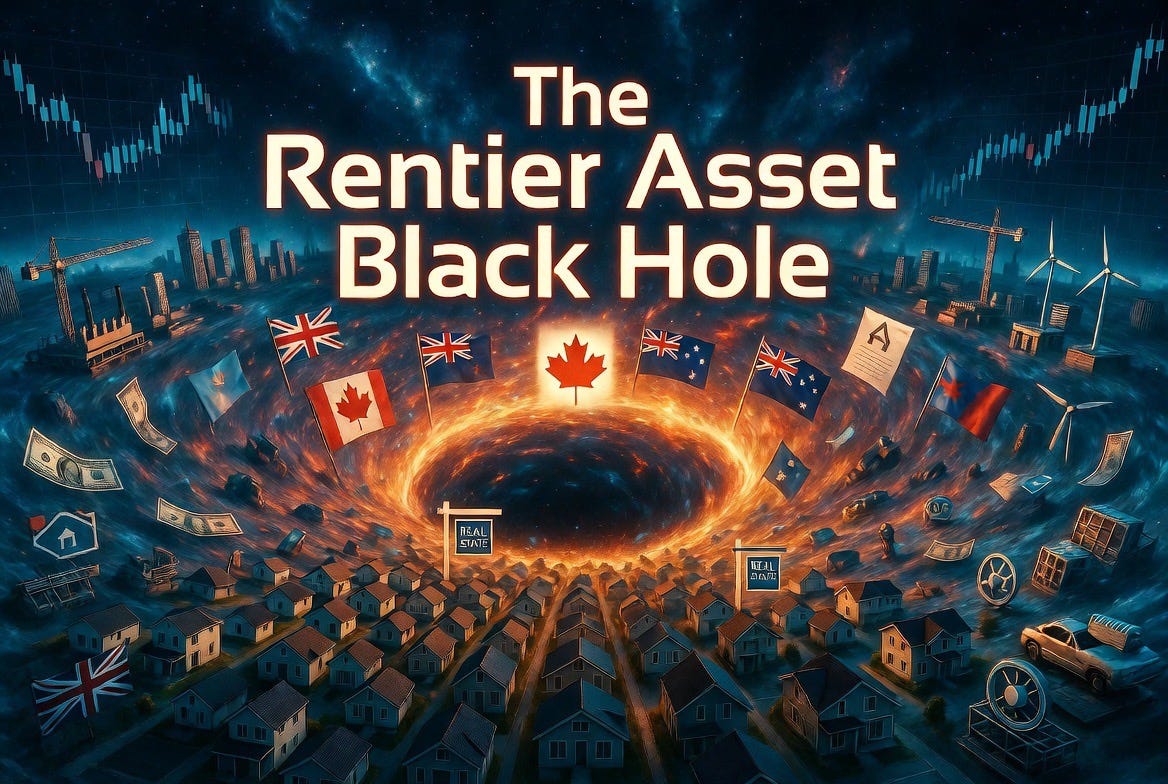
There’s a massive black hole devouring the Western economies, and it’s been expanding for decades. Year after year, it pulls in huge amounts of money that could have gone toward building real infrastructure, new factories, better technology, and actual productive growth, only to pump it straight into ever higher home prices.
This might be one of the biggest overlooked explanations for why so many Western economies feel stuck despite the official numbers. The same destructive pattern is playing out in the UK, Australia, and New Zealand.
In a healthy economy, when prices for something rise, the market responds by increasing supply. Capital flows in, production ramps up, and things balance out. Simple self-correction that keeps everything stable.
But picture an asset class where supply is basically fixed no matter how much money chases it. Think prime urban land or housing stock in big cities. Flood it with investment, and the only result is higher prices. No new quantity appears to meet the demand.
Let's call it the rentier asset black hole.
It works in clear stages:
1. It keeps growing through accumulation. Rising prices make it look like a better bet, so more capital rushes in, driving prices even higher in a self-reinforcing loop.
2. It distorts all surrounding decisions. Capital that ought to fund productive businesses or infrastructure gets diverted because the risk adjusted returns on housing crush everything else, especially with leverage and tax breaks thrown in.
3. It reaches a point of no return — an event horizon where the usual economic rules stop working the way they should. What used to be diminishing returns to capital flips completely, and the unproductive asset starts offering stronger pull than real growth opportunities.
4. The headline GDP figures and bank balance sheets look decent because they capture the asset inflation and imputed rents, but the missed factories, stalled innovation, and hollowed out real economy stay invisible.
Looking at Canada, in places like the Greater Toronto Area, we’ve seen housing prices detach completely from wages. Working families struggle while GTA detached homes trade well above the $1 million mark and require 63% of a typical household’s income just to service ownership costs. High immigration boosts demand, strict zoning blocks supply, easy mortgage credit treats homes as the ultimate safe asset, and governments celebrate the “wealth effect.” Meanwhile, the money that could revive manufacturing, mining, or critical projects sits parked in real estate.
The bill lands squarely on young Canadians choosing between rent and groceries.
The UK has been dealing with this for even longer. London and the South East became the prime example decades ago. As industry declined and capital shifted, housing became the dominant attractor, with London homes selling for over 10.5 times average earnings. The financial sector ballooned by lending against it, while the productive base shrank. Same pattern: strong numbers on paper, but a weakened real economy underneath.
Australia and New Zealand mirror the pattern exactly. Sydney homes command 13.8 times median income, with Melbourne and Auckland locked in the same cycle —exploding prices, a generation largely priced out of ownership, and capital flowing away from businesses that actually create things.
These countries share similar property laws, cultural attitudes toward real estate, and policy incentives that supercharge the cycle.
Leaders across the spectrum have allowed it because rising asset values feel like success, banks get safe collateral, and the benefiting class has influence. But basic economics, geography, and math don’t bend to wishful thinking. You can’t build a strong, innovative nation when the best capital is endlessly chasing fixed location property instead of creating value.
Time to name this beast and get capital building the future again, before the next generation inherits nothing but rent receipts.
Already in the 90s my father was flippant that the 2nd home he had bought in the early 80s had multiplied its price x10 (I write from the Basque Country for clarity but I believe it's the same in Britain and the USA). The population was not growing, tourism was not yet much of a thing, there was no driver for such massive appreciation of housing. Then a better informed friend told me about how real state agencies bought each other's empty homes to keep the prices inflated.
It was the Neoliberal credit bubble, which, in spite of the 2008 crisis (which should have burst the bubble and let the TBT banks fall as deep as required by free market logic), was extended for nearly two decades more, now under the control of the so-called investment funds, which own each other and are an effective financial monopoly extending through all the US Empire.
Our homes is where the mega-rich store their value, in implicit financier trickstery to keep their price tag always rising. That devours our lives, makes rising children extremely difficult (housing cost is the main driver of the demographic crisis), increases real salaries (workers naturally keep demanding salaries that allow for at least individual survival: nobody can work for less than it takes to survive, not for long anyhow) and thus decreases productivity, devastating the real (productive) economy, which had to emigrate to greener pastures, notably China. It's not a "globalist conspiracy" but the worst possible logic of unregulated Capitalism.
Now the US Empire tries to fix all that without adressing the root causes (financiarization, speculation, "everything bubble") by resorting to more of the same: ultra-petrolism and ultra-militarism, edging nuclear armaggedon even at times. It cannot work but the alternative for the oligarchs is losing wealth and power and establishing some sort of eco-socialism... and that's a no-no for them.
The amount of money taken out of the economy especially in the South East/London region of the UK through mortgage & rent costs. Cannot be understated, the amount of disposable income for the average person on the UK. I've seen shrink massively over the past 4 decades. In the housing market the region I live in has the cheapest property to buy. Which is great for the people of my region. But it's just a fraction of the UK that's the same. But even my region is seeing prices rise to out of reach levels for young couples. It's dead money when all things are considered. The only ones proffitting are the same old Banking cartels who always profit. I still can't get my head around the public bailing banks out in 2008. Yet not receiving a public share in the ownership of the see banks. It was theft on a grand scale.